
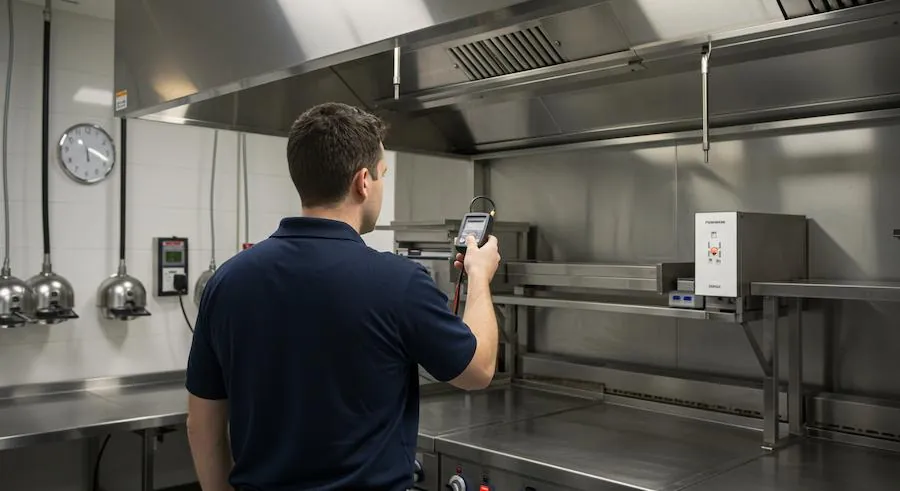
That is why regular cleaning is mandatory
When we talk about fire risk in a professional kitchen, we automatically think of open flames, hot oil in the fryer or high-output grills. These are indeed significant sources of risk, but fire safety specialists know that a commercial kitchen fire often becomes truly dangerous not where it starts, but where most people no longer see it: inside the exhaust system.
The greasy aerosols produced during cooking do not simply disappear. Some of them settle in the exhaust hood, but others travel on through the duct towards the fan, where they gradually build up an ever thicker layer of grease. If this deposit is not removed for a long time, the duct itself can become a path for fire to spread in the event of a kitchen fire.
That is exactly why Hungarian fire safety regulations and the related technical guidelines require regular inspection and cleaning of greasy exhaust systems. The purpose of cleaning is therefore not primarily aesthetic or hygienic but, above all, fire safety.
The grease does not stay in the air
Frying, grilling, wok cooking or deep-frying do not simply produce water vapour. At high temperatures fats break down into extremely tiny droplets which, suspended in the air, form what is known as grease aerosol.
An aerosol is a collection of tiny liquid or solid particles suspended in the air. Kitchen aerosol typically consists of grease droplets, water vapour, soot particles and various organic compounds.
Freshly formed grease droplets are still hot, so they easily travel with the airflow to the exhaust hood. In the ventilation system, however, the temperature gradually drops. As a result the viscosity of the grease droplets increases, they partly condense and stick more and more easily to the duct wall.
This is an entirely natural physical phenomenon. It is not caused by a poor-quality hood, a faulty fan or improper operation; it simply follows from the behaviour of greasy aerosols.
Why does it settle exactly there?
Anyone who looks inside a duct that has not been cleaned for some time will often find that the deposit is not at all uniform. Some sections are almost clean, while elsewhere there is a thick, sticky layer of grease.
The reason lies in fluid dynamics.
Particles do not follow the airflow in the same way everywhere. When the air changes direction – for example in an elbow – larger grease droplets can no longer follow the streamlines exactly because of their inertia. They hit the duct wall and stick there in a gradually accumulating sticky layer. This phenomenon is called inertial impaction.
For a similar reason, heavier deposits also form on fan blades, in the fan housing, at changes in cross-section, in T-pieces and in longer horizontal duct sections.
The process is self-reinforcing. After the first thin film of grease, further particles adhere much more easily, so the thickness of the deposit can grow faster and faster over time.
A fire safety specialist sees this layer differently
For most operators, grease deposits are primarily a cleaning problem. A fire safety specialist, however, sees them quite differently.
To them it is combustible material – in other words, fuel.
If a flame from a pan or fryer reaches the exhaust hood, it can often still be contained. But if a significant amount of grease has already built up in the duct, the situation changes radically. The deposited grease can ignite, and from then on the duct no longer just carries air – it becomes a potential path for fire to spread.
This is the point where regular cleaning is no longer a maintenance issue but an active fire prevention measure.
What do the standards and Hungarian regulations say?
The cleaning requirements for commercial kitchen exhaust systems are not arbitrary. They are based on many years of operating experience and the analysis of fire incidents.
In Hungary the basic fire safety requirements are set out in the National Fire Safety Code (OTSZ), supplemented with practical guidance by the Fire Safety Technical Guidelines (TvMI). The TvMI deals specifically with the inspection, review and maintenance of ventilation systems, covering the cleaning of greasy exhaust systems, documentation and the role of access openings.
Internationally, the EN 16282 series of standards can be regarded as one of the most important technical documents for professional kitchen ventilation systems. The standard places particular emphasis on systems not only working well but also being properly inspectable and cleanable. This is why, for example, suitable access points are required.
Designers are also widely familiar with the German VDI 2052 guideline, which gives detailed recommendations for the design, operation and cleaning of commercial kitchen ventilation systems. Although it is not law in Hungary, it is often used as a reference document in professional practice.
Why isn't it enough to clean just the baffle filter?
The baffle filter is an important part of a kitchen exhaust system, but by its operating principle it is mainly suited to separating larger grease droplets. Some of the finer aerosols travel on towards the duct, where they can gradually settle.
That is why significant contamination may already be present in the ductwork behind an exhaust hood that looks spotless from the outside. Daily cleaning is therefore no substitute for periodic, professional cleaning of the whole system.
Cleaning does more than serve fire safety
The grease layer is not only combustible but also unfavourable from a ventilation point of view.
Deposits increase the flow resistance of the duct system, reduce fan efficiency, can increase electricity consumption and can adversely affect extraction performance. As a result, capture above the cooking equipment may deteriorate, the kitchen's heat load may rise and the comfort burden on staff may increase.
The same grease layer is therefore a fire safety, energy, hygiene and operational problem all at once.
The insurance aspect that is rarely discussed
After a significant kitchen fire, the first priority is of course to prevent injuries and assess the damage. After that, however, an investigation into the cause and circumstances of the fire almost always begins.
In such cases the insurer examines not only the extent of the damage but also whether the operator acted with due care. This may include checking whether maintenance and cleaning records are available, whether inspections were documented, and whether the system was operated in line with the applicable regulations.
It is important to stress that a lack of documentation does not in itself mean that the insurer will refuse to pay. Claims are always settled on the basis of the insurance contract and the outcome of the investigation. However, properly documented maintenance can make it much easier to prove that the operator took the measures that could reasonably be expected.
If the fire spreads to other tenancies or other parts of the building, not only property insurance but also liability insurance issues may arise, and the economic consequences of any business interruption can also be significant.
Prevention is the best fire safety investment
Many people regard the ventilation systems of professional kitchens as mere auxiliary equipment. In reality, however, these systems also play a key role in fire safety.
Regular cleaning is not just ticking off an official obligation. Its purpose is to remove the combustible material that naturally builds up in the system over time. At the same time it improves the operation of the ventilation system, can reduce energy consumption and can help the operator demonstrate responsible, professional operation in any insurance or official investigation.
In modern hospitality, ventilation maintenance is therefore no longer a simple operational task but the intersection of fire safety, energy efficiency, regulatory compliance and business continuity.
The way forward: active grease treatment, not just separation
The development of professional kitchen ventilation in recent years shows a clear direction. While the primary goal of conventional systems was to separate greasy aerosols, modern solutions aim to reduce the formation of deposits themselves.
A significant step forward here is AirQuality Technology (AQT) ESP+UV technology, represented in Hungary by Nuxon Kft.
In the first stage of the system, the electrostatic precipitator (ESP) separates the vast majority of airborne grease aerosols with high efficiency while maintaining a low pressure drop. The subsequent UV treatment stage no longer mainly performs further mechanical separation; instead it photochemically breaks down the remaining fine grease aerosols and organic compounds.
High-energy UV radiation converts larger organic molecules into smaller ones, while a significant part of the remaining aerosols loses its sticky character. Among the resulting oxidation products are drier, powder-like particles that are much less inclined to stick to the duct wall. As a result, grease deposits in the duct system can be significantly reduced.
This does not mean that maintenance or inspection of the system becomes unnecessary – the applicable fire safety regulations still require it – but reducing the formation of deposits can contribute to safer and more economical operation in the long term.
That is why, in Nuxon's professional view, it makes sense to use an ESP+UV combined system from the outset in new kitchen projects or major refurbishments. Electrostatic precipitation and the subsequent UV treatment complement each other: they not only increase particle separation efficiency but, by reducing grease deposits in the duct, also help lower fire safety and operational risks.
The first step in commercial kitchen fire prevention is not firefighting but preventing combustible deposits that could spread a fire from forming in the duct in the first place. Modern ventilation systems therefore serve not only to remove smoke and grease but also to reduce the formation of deposits. The right technology, regular maintenance and documented cleaning together form the three pillars on which a professional kitchen can operate safely and sustainably in the long term.