
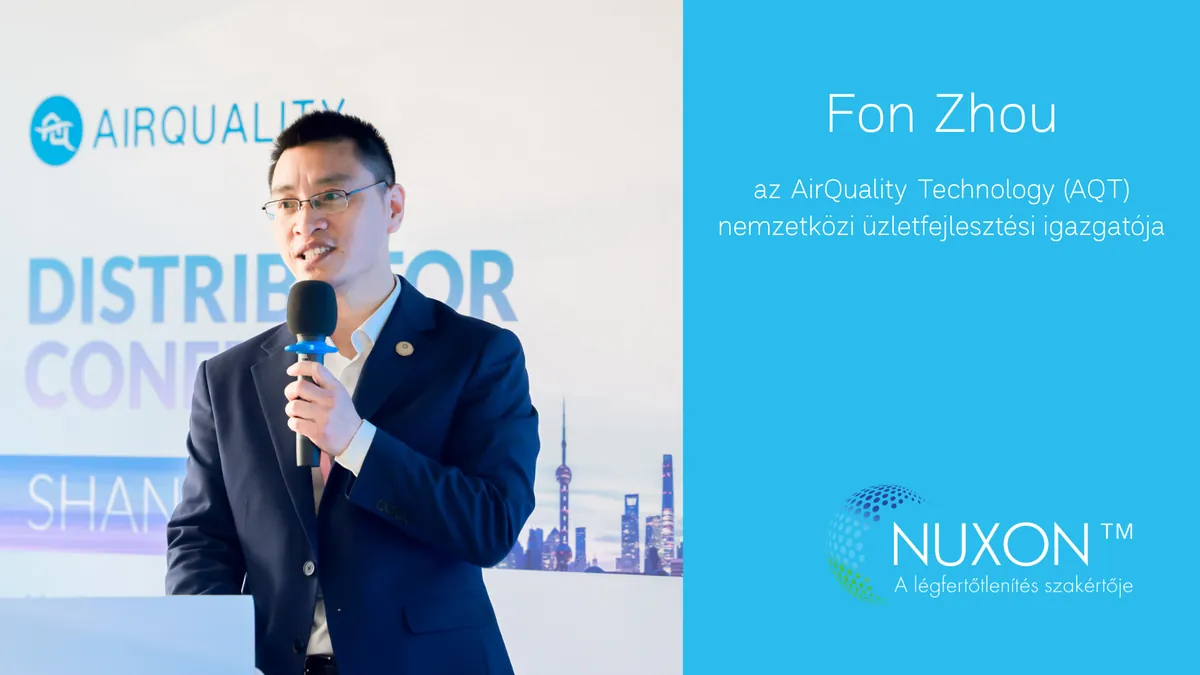
Mr Fon Zhou, International Business Development Director at AirQuality Technology (AQT), recently visited Hungary. On this occasion I had the opportunity to meet him in person and talk about the ever-changing world of air treatment solutions and the role of NUXON Hungary, the official Hungarian distributor of AirQuality products.
As environmental regulations in the European Union become stricter and businesses increasingly look for sustainable solutions, air purification technology is becoming more important than ever. Mr Fon Zhou shared valuable insights into market growth, technology trends and future growth strategies, highlighting in particular how companies can adapt to changing expectations and how they should invest in innovative air treatment solutions.
From large hospitality venues and healthcare facilities to industrial applications and compliance with EU air quality directives, there is growing demand for advanced air purification systems. This trend creates exciting opportunities for innovative businesses committed to sustainability.
Read our report to learn how NUXON Hungary and AirQuality Technology work together to deliver cutting-edge solutions for cleaner, healthier air.
Which areas do you consider most promising for NUXON's future growth? Are there sectors – such as healthcare, industrial manufacturing or energy – that stand out for you in particular?
Based on our international experience, we see significant growth potential in sectors such as healthcare, hospitality venues, ESG-focused commercial property and air treatment in industrial manufacturing. These segments increasingly prioritise indoor air quality and emission control, which makes them especially promising for sustainable air treatment solutions.
What vision does NUXON have for the next five years? How do you see EU and domestic market trends developing, and what strategies do you use to maintain a leading position?
The vision for the next five years is best developed together. My personal recommendation is that NUXON should aim to become the preferred supplier of air treatment solutions in Hungary and in the EU.
The European Union has significantly tightened air quality regulations, aligning national measures with the overall EU policy framework. Food and hospitality companies need to pay increasing attention to local regulations – especially regarding air filtration equipment and emission limits – and invest in green technologies to adapt. In future the EU is expected to harmonise emission standards for restaurants, which could trigger widespread technological development in the sector. This trend creates significant growth opportunities in the market for professional air treatment services.
The future of EU air quality regulation:
Regulatory framework:
The revised Ambient Air Quality Directive (Air Quality Directive) of 2024 sets target values for outdoor air, which indirectly also affect indoor air quality. For example, the annual PM2.5 limit will be 10 μg/m³ from 2030, and continuous monitoring of 12 pollutants (e.g. SO₂, NO₂, O₃) becomes mandatory. Member states must improve the quality of data collection and ensure compensation mechanisms for damage to health.
The Energy Performance of Buildings Directive (EPBD) requires the installation of efficient ventilation systems – for example high-efficiency units with fresh air supply – in new and renovated buildings.
Hospitality – emission control:
The Industrial Emissions Directive (IED) regulates large-scale food preparation facilities (e.g. central kitchens, food processing plants) and requires the use of best available techniques (BAT) – e.g. high-efficiency fume extraction systems – as well as regular emission reporting.
Some member states may also apply stricter local rules: for example banning new catering outlets in residential buildings, or setting PM2.5 and VOC emission limits based on WHO recommendations. Companies that break the rules can face fines of up to EUR 50,000 or suspension of their activities.
Technological innovation and funding:
The EU supports clean energy (e.g. hydrogen fuel cells) and low-emission technologies that reduce dependence on fossil energy and life-cycle carbon emissions.
Tools such as the Zero Pollution Dashboard provide real-time data for tracking and optimising the effectiveness of emission reduction.
Challenges and trends:
Enforcement of the regulations varies between member states: it is weaker in Southern Europe and stricter in Northern Europe.
Following the EU's Zero Pollution objective, the hospitality industry is under increasing pressure to use AI-based, smart filtration systems – these enable real-time monitoring and dynamic control.
Summary:
The EU is expected to further harmonise hospitality-related emission standards across member states, which could lead to technological renewal across the industry. Food and hospitality companies should already follow local regulations closely – regarding filtration equipment and emission limits – and invest in green technologies in good time to adapt to ever stricter expectations.
What are the most significant differences in market dynamics between Hungary and China that NUXON has had to adapt to?
Although the European Union as a whole has set strict environmental and indoor air quality standards, detailed and enforceable regulations are still missing in certain specific areas of application – and this often makes practical implementation challenging. In the commercial kitchen sector, for example, China has not only national regulation of cooking oil fume emissions but also local regulations in major cities such as Beijing and Shanghai, which are often even stricter. In Europe, by contrast, no uniform, detailed system of standards has yet emerged in this area. However, it is a welcome development that, according to NUXON, new regulations on emissions from commercial kitchens have recently come into force in Budapest – this progress fits well with AirQuality Technology's solutions and also offers a well-timed opportunity for our business expansion.
The other major challenge lies in the level of market awareness and the acceptance of new technologies. AQT's advanced indoor air quality solution – technology based on micro-electrostatic precipitation (MESP) – is still at an early stage of adoption in Europe. In China, by contrast, MESP is already widely recognised: industrial consultants, design institutes and other professionals know it well and regularly recommend it for large-scale projects. This contrast highlights an important difference and also a strategic opportunity: building on its proven track record in mature markets such as China, AQT can actively support market education and accelerate the adoption of MESP technology in regions such as Hungary – and beyond.
How does AQT's team in China encourage creativity and innovation? Are there unique initiatives – such as internal competitions, training programmes or professional collaborations – that specifically support these skills?
AQT is a highly dynamic and innovation-driven team, where encouraging creativity is an integral part of the company culture – especially in our office in China. Every quarter we hold an innovation competition, and the winners are recognised as role models for their innovative thinking and for pushing the boundaries of their field. This initiative has become a tradition – I have had the honour of winning such an award myself. I am convinced that the NUXON team works in a similar spirit: we believe that real breakthroughs in business development and industrial applications come when we boldly break with convention and go beyond familiar boundaries.
How would you describe Hungary's technology and innovation scene? What makes this region particularly valuable for AirQuality?
Hungary is extremely open to new technologies and innovative solutions. With a solid industrial base and advanced infrastructure, it is a strategically important location for AQT. In addition, the country's industrial sector often serves other EU regions – especially Germany – which gives it the opportunity to lead in introducing advanced technologies and exploring new business models. Hungary can thus set an example for the wider European market. That is why I consider NUXON's activities in the region particularly important, and I follow its progress and success there with great pleasure.
How do you see technology developing to address the pressing global challenges facing industries? Are there specific areas where AQT aims to lead these developments?
Ultimately it is new technologies that move the industry forward, and the partnership between NUXON and AQT – which aims to introduce proven ESP technology (including the patented Vortex-ESP) for kitchen and industrial pollution control applications, and advanced, exclusive MESP technology for IAQ applications (IAQ: indoor air quality) – covers areas where NUXON has strong growth prospects.
How do you see NUXON's vision and values as a partner? Do you have any suggestions or insights you would like to share with the NUXON team to support continued growth and success?
First of all, NUXON has its own strong and competent team, an established company culture and a clear vision. From the very beginning we recognised that NUXON's values and mission are closely aligned with AQT's principles – which is exactly why we decided to work together. We see two like-minded organisations working together towards shared goals in innovation and improving air quality.
If I had to make a general recommendation – purely for the NUXON team – I would put it like this:
NUXON mission: "To provide clean, safe air in every room in Hungary – with state-of-the-art electronic purification technologies."
NUXON vision: "To become Hungary's best-known and most trusted company in sustainable air filtration solutions."
What sets NUXON apart from its competitors in terms of innovation, approach or customer focus?
IAQ solution: NUXON uses AQT's micro-electrostatic precipitation (MESP) technology and solutions, which have been successfully introduced in the Chinese market for almost a decade, with more than 10,000 successful projects. Over the past three years this technology has also gained significant ground in other regions – such as the United States, India, Southeast Asia and South Africa – and has received wide recognition. This technology is set to transform the industry by delivering tangible value to customers.
Kitchen and industrial air pollution control solution: Drawing on R&D and manufacturing capacity in China, our advanced electrostatic precipitation (ESP) solutions offer optimal value for money for the Hungarian market.
As the official representative of AQT in Hungary, NUXON offers complete product and technology solutions and long-term after-sales support. We believe that this combined value proposition sets us apart from competitors and earns both market recognition and customer trust.
Aljona Jakimenko
Marketing and Communications Manager - Mielemed MPM Kft