
How does MESP work?
MESP® – micro-electrostatic precipitation – first electrically charges airborne particles and then captures them in the strong electric field of an insulated honeycomb filter. In this way it removes dust, soot, smoke, pollen and mould spores, and inactivates viruses and bacteria.
Operating principle
The four steps of precipitation
Corona discharge
The charging grid creates a corona discharge at about –10.2 kV. The high-energy electrons released generate further electrons in an avalanche, and negative ions are formed.
Charging the air
Moving away from the corona zone, the negative ions transfer charge to surrounding air molecules, which the strong electric field moves towards the positive plates.
The particles collect charge
The fine particles attract negatively charged molecules and keep collecting charge until they are saturated.
Capture in the matrix
The electric field of the dense MESP matrix attracts the charged particles towards the positive plates and captures them on their surface.
The honeycomb filter
The filter is made up of layers of insulating polymer tubes; the internal spacing of the tubes is only 1.8 mm, and thin electrodes run through each row. The insulation prevents current from flowing between the electrodes, even in an intense electric field.
Because of MESP's distinctive voltage–current characteristic, the current is extremely low even at high voltage: this creates a strong electric field and safe operation without arcing or sparking. The filter is washable, has little effect on airflow velocity, and the manufacturer designed it for a service life of more than 10 years.
You can read about applications and sizing in air handling units on elektrosztatikusszuro.hu.
Inactivating pathogens
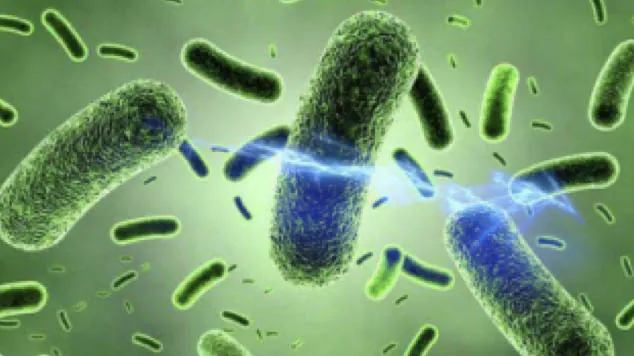
1. Electrostatic field. In the filter's electrostatic field of up to 10,000 V, the cell walls of passing bacteria and the protein coats of viruses are damaged, so the microorganisms are destroyed.
2. Continuous inactivation. Viruses and bacteria captured on the filter surface are continuously inactivated. According to the manufacturer, MESP captures particles as small as 0.01 µm, including biological pollutants.
The key features
- According to the manufacturer: 99% efficiency for PM2.5 particles, 99.96% for bacteria and 99.99% for viruses.
- Washable, reusable filter – no regular filter waste.
- Can be reused immediately after washing, with no loss of efficiency.
- Practically ozone-free operation (manufacturer data).
- No electric arcing, sparking or risk of electric shock.
- Flame-retardant filter material.
- Operating range: –15…50 °C, up to 100% relative humidity.
History
Milestones of electrostatic precipitation
- 1824
Hohlfeld, a German mathematics teacher, suggests that smoke particles can be separated using electricity.
- 1906
F. G. Cottrell at the University of California (Berkeley) develops the first industrial electrostatic precipitator.
- 1907
The first industrial electrostatic precipitator goes into operation near San Francisco.
- Since 1955
Electrostatic dust precipitation becomes widespread in industrial smoke and dust control and in air cleaning.
- 1980
Masuda and colleagues use high-voltage, narrow-pulse power supplies in dust precipitation.
- 1996
Electrostatic technology is used for the first time in the ventilation system of a large road tunnel.
- 1998
The concept of the membrane electrostatic precipitator is proposed at Ohio University.
- 2005
Electrostatic air cleaning using an intense-field dielectric appears in the United States.
- Since 2014
AirQuality Technology spreads MESP technology in industrial and building services applications.

Contact
Tell us what problem you want to solve.
You don't need to arrive with a ready-made technical solution. A short description of the problem and the operating environment may be enough to choose the right first step.